At Nancledra School, English sits at the heart of our curriculum. We believe that strong literacy skills open doors for children—academically, socially, and in their future lives. Our aim is for every child to become a confident, capable reader, writer, speaker, and listener, equipped with the language skills they need to thrive.
English is taught daily as a discrete subject, but it also underpins learning across the whole curriculum. High‑quality texts, rich vocabulary, and meaningful opportunities for communication are woven through every subject. We set high expectations for all pupils and provide expert, explicit teaching to help them develop the skills to:
- read with understanding and insight
- write for a range of purposes and audiences
- speak clearly and confidently
- listen attentively and respond thoughtfully
By building these foundations, we ensure that every child can access the full curriculum and step confidently into the opportunities ahead of them.
Our Approach:
Intent, Implementation and Impact
Intent
Children make a strong start to writing in Reception through the systematic teaching of phonics alongside Drawing Club. These approaches develop early transcription, communication, vocabulary and storytelling skills, ensuring children are well prepared for the school's writing curriculum and develop confidence as early writers. At Nancledra, we use Little Wandle phonics scheme.
Following the completion of the school's systematic phonics programme, pupils move into a carefully sequenced writing curriculum designed to develop confident, fluent and purposeful writers who can communicate effectively for a range of audiences and purposes.
Our writing curriculum is designed to develop confident, fluent and purposeful writers who can communicate effectively for a range of audiences and purposes. Rooted in the TPAT Writing Curriculum principles of Purpose, Ideas, Development and Fluency, the curriculum ensures that all pupils acquire the knowledge, skills and vocabulary needed to become successful writers. Pupils are taught to write for real purposes and audiences, develop ideas through rich talk and reading, understand writing as a process and build fluency through secure transcription skills. High expectations are maintained for all pupils, including those with SEND, through adaptive teaching, structured talk and carefully planned support.
The curriculum is underpinned by the belief that writing is both a cognitive and creative process. Through carefully sequenced opportunities to talk, read, rehearse, write, revise and edit, pupils develop increasing independence and confidence as writers.
Implementation
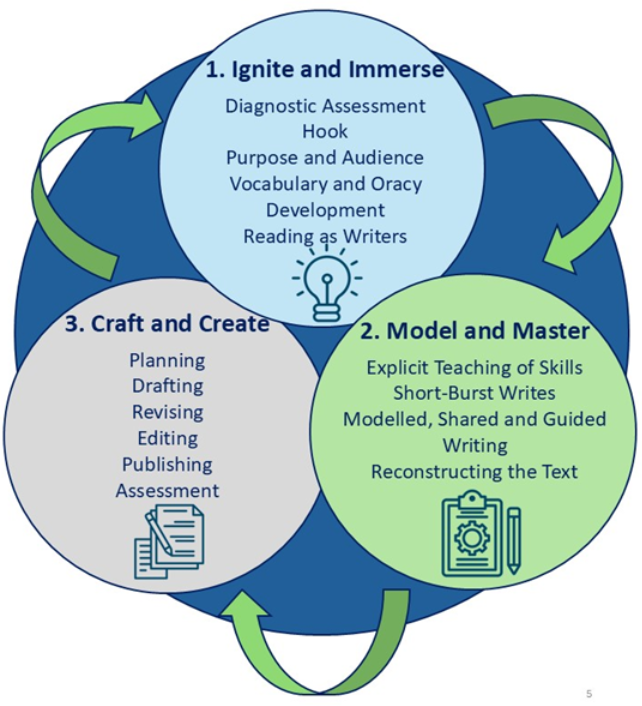
Writing is delivered through a consistent three-phase structure:
Ignite and Immerse
-
Diagnostic assessments identify prior knowledge and misconceptions.
-
High-quality texts, experiences and hooks engage pupils and establish a clear purpose and audience.
-
Vocabulary, oracy and reading-as-writers activities develop ideas and language before writing begins.
Model and Master
-
Teachers explicitly teach grammar, vocabulary, sentence structures and writing techniques.
-
Modelled, shared and guided writing support pupils through the "I do, We do, You do" approach.
-
Short-burst writing and text reconstruction provide opportunities to practise and apply newly taught skills.
Craft and Create
-
Pupils plan, draft, revise, edit and publish writing for meaningful outcomes.
-
Teachers provide regular feedback and opportunities for pupils to refine and improve their work.
-
Assessment is embedded throughout the writing process to inform teaching, identify misconceptions and secure progress. AIR Education is used to support teachers in reviewing outcomes and informing professional judgement.
Oracy is a central feature throughout the curriculum. Pupils are explicitly taught speaking and listening skills and are provided with regular opportunities to rehearse vocabulary, sentence structures and ideas before writing. This strengthens both thinking and composition.
In Reception, early writing is underpinned by the school's chosen SSP alongside Drawing Club. Writing opportunities are closely aligned to pupils' secure phoneme-grapheme correspondence knowledge so that children are expected to write only with the sounds and spelling patterns they have been explicitly taught. This carefully sequenced approach enables children to apply and consolidate their phonics learning in meaningful contexts while developing confidence as writers. Through Drawing Club, high-quality texts, storytelling, talk and vocabulary exploration provide rich experiences that support idea generation, oral rehearsal and early composition. As pupils progress into Year 1, this strong foundation is built upon through continued phonics teaching and structured writing opportunities that bridge the transition from sentence-level work to extended writing.
To support transcription, discrete handwriting and spelling sessions are taught in addition to writing lessons:
-
Handwriting is taught in daily 10-15 minute sessions to develop fluent, legible and automatic letter formation and joins. This supports pupils in securing handwriting fluency, reducing cognitive load and enabling greater focus on composition. At Nancledra, we use Penpals handwriting scheme.
-
Spelling is taught through discrete 10-15 minute sessions once phonics teaching is complete. Learning focuses on phonics, orthography and morphology, ensuring spelling patterns, common exception words and word structures are explicitly taught, practised and revisited. At Nancledra, we use Emile spelling scheme.
Retrieval practice is systematically planned across handwriting, spelling and writing. Previously taught letter formations, joins, spelling patterns, common exception words and grammatical concepts are revisited through daily practice, dictation, retrieval activities and cumulative review. In Key Stage 1, daily dictation supports the retrieval and application of phonics, spelling, handwriting and sentence construction. In Key Stage 2, daily Key Skills sessions provide regular opportunities to retrieve and apply previously taught grammar, punctuation and spelling knowledge alongside new learning. This deliberate approach strengthens long-term retention, secures automaticity and supports pupils in transferring knowledge successfully into independent writing.
Impact
As a result of this approach, pupils develop into confident, articulate and enthusiastic writers who can write effectively for a range of purposes and audiences. They demonstrate increasing fluency in transcription, allowing them to devote greater attention to composition, vocabulary choices and authorial intent.
Pupils:
-
Write with stamina, independence and enjoyment.
-
Use ambitious and purposeful vocabulary drawn from reading and discussion.
-
Apply spelling, punctuation and grammar accurately and increasingly automatically.
-
Produce writing that is coherent, well-structured and appropriate for its intended audience and purpose.
-
Retain and apply previously taught knowledge through regular retrieval and practice.
-
Develop positive attitudes towards writing and see themselves as successful writers.
Over time, pupils make strong progress from their individual starting points, leaving each year group with increasing knowledge, fluency and independence as writers.
Spelling at Nancledra School
At Nancledra School, we believe that strong spelling skills are essential for confident communication, fluent writing and lifelong learning. We want our pupils to understand not only how words are spelt, but also why words are spelt in particular ways.
To support this, we use the Emile Spelling Scheme, a comprehensive programme that is fully aligned with the National Curriculum and provides a clear, progressive approach to spelling from Year 1 to Year 6.
Our Approach
Spelling is taught explicitly through regular lessons that build pupils' knowledge and understanding over time. Through the Emile scheme, children learn:
- Key spelling rules and patterns
- Common Exception Words
- Statutory word lists for Years 3/4 and Years 5/6
- Strategies for applying spelling knowledge across the curriculum
- The meanings and origins of words
- How word structure can support accurate spelling
As children progress through the school, they are encouraged to explore how words are constructed and connected. This deeper understanding helps them become more confident and independent writers.
A Focus on Morphology
A key feature of the Emile scheme is its focus on morphology: the study of word parts and how they create meaning. Children learn about prefixes, suffixes, root words and word families, helping them to make links between vocabulary, spelling and meaning.
By understanding how words are built, pupils are better equipped to:
- Spell unfamiliar words accurately
- Develop a richer vocabulary
- Recognise patterns in language
- Improve their reading comprehension and writing skills
Engaging and Effective Learning
Lessons are supported by a range of high-quality resources, including:
- Interactive teaching presentations
- Practice activities and worksheets
- Assessment opportunities
- Games and online learning activities
Children are encouraged to apply their spelling knowledge in their everyday writing, helping them to transfer skills from spelling lessons into authentic contexts.
Building Confident Writers
Our aim is for all pupils to leave Nancledra as confident, capable writers who have a strong understanding of spelling patterns, word meanings and vocabulary. Through a carefully sequenced curriculum and consistent teaching approach, we support every child in becoming a successful and enthusiastic learner of language.